


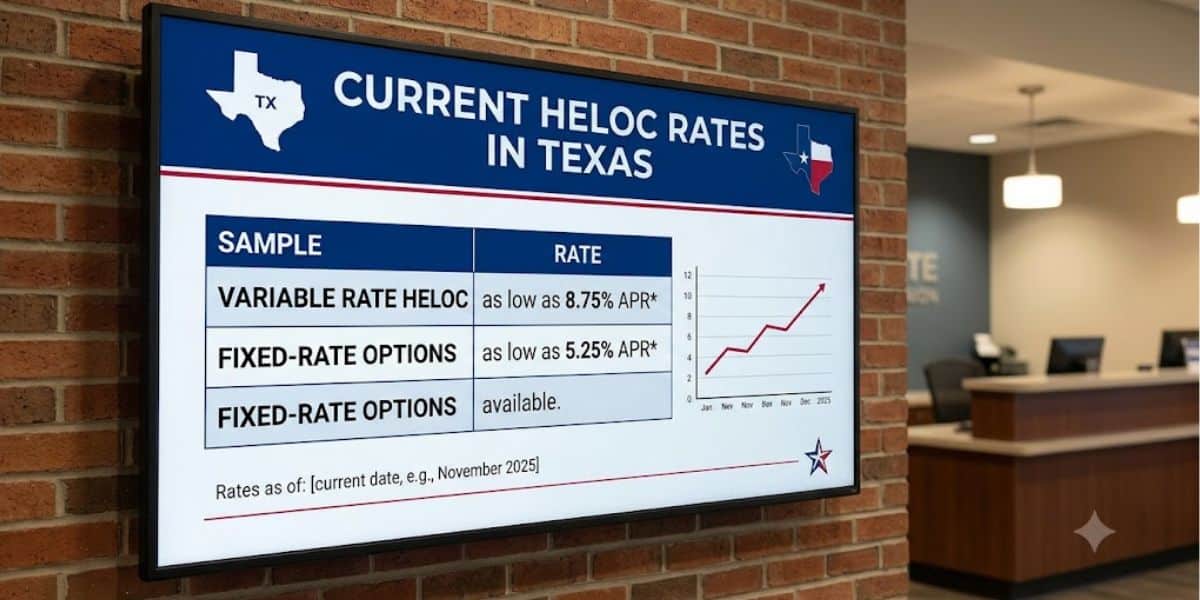
A home equity line of credit, or HELOC, allows homeowners to borrow against the equity they have built in their property and draw funds as needed instead of receiving a single lump sum. In Texas, HELOC pricing has become more consistent through 2026 after several years of volatility, but state-specific rules continue to make home equity lending different from most other parts of the country. Understanding both the current rates and the legal requirements is important before signing a home equity agreement in Texas.
As of September 2026, national average HELOC rates are approximately 7.3% to 7.4% APR, while Texas borrowers see an average closer to 7.9%. Across the broader market, including different credit tiers and lender types, rates generally range from approximately 8.25% to 13.25% APR. Promotional introductory rates from some credit unions can fall below 5%, and occasionally as low as 3.99%, for a limited period of six to twelve months before converting to a different rate.
Current Texas HELOC Rate Snapshot
| Rate Type | Typical Range (APR) |
| National Average HELOC | ~7.3% – 7.4% |
| Texas Average HELOC | ~7.9% |
| Broad Texas Market Range | 8.25% – 13.25% |
| Credit Union Promotional Rates | 3.99% – 6.49% (intro) |
| Prime Rate (index) | 6.75% |
These figures move with the Federal Reserve’s benchmark rate decisions, since most HELOC are variable and tied to the prime rate plus a lender-specific margin. The prime rate has held at 6.75% since December 2025, which has kept HELOC pricing relatively steady compared with the sharper swings seen in prior years. A typical Texas lender margin runs from about 0.25% to 2.00% over prime, meaning your actual rate will depend heavily on your credit profile, loan-to-value ratio, and the lender you choose.
What Determines Your HELOC Rate?
Lenders don’t offer the same rate to every borrower. Instead, each HELOC is priced based on a combination of factors:
- Credit score: Borrowers with scores of 720 or higher typically qualify for the lowest margins, while those closer to the 620-640 range may pay noticeably more.
- Combined loan-to-value ratio (CLTV): Texas law caps total mortgage debt, including the HELOC, at 80% of the home’s appraised value. This is tighter than the 85% or higher limits allowed in many other states.
- Line size: Larger credit lines sometimes receive slightly better pricing, although this varies by lender.
- Draw period structure: Interest-only draw periods, commonly five to ten years, usually result in lower initial payments than lines that begin amortizing immediately.
- Lender type: Credit unions and regional community banks may offer lower margins than large national banks, even though Texas lenders operate under the same state requirements.
- Introductory promotions: Many lenders offer a fixed low rate for the first six to twelve months. After that introductory period, the rate becomes variable and will typically adjust higher.
Texas-Specific Rules Every Borrower Should Know
Texas is unique because home equity lending is governed directly by the state constitution rather than being left entirely to lender discretion. Article XVI, Section 50(a)(6) of the Texas Constitution, along with related provisions in the Texas Administrative Code, establishes several protections and restrictions that affect how HELOCs work in the state:
- 80% CLTV cap: Total home debt, including the new HELOC, cannot exceed 80% of the property’s fair market value.
- One home equity loan at a time: Homeowners may only have one home equity loan or HELOC against a homestead at any given time.
- 12-day cooling-off period: Borrowers must wait at least 12 days after applying before closing, giving them time to review the terms.
- Three-day right of rescission: After closing, borrowers can cancel the loan within three business days without penalty.
- Mandatory disclosures: Texas requires specific disclosures about the risks of home equity borrowing that aren’t required in many other states.
- Homestead protections: Because a HELOC is secured by a primary residence, Texas’s homestead protection laws add procedural safeguards that borrowers should understand before closing.
These rules exist because Texas historically restricted home equity borrowing entirely until a 1997 constitutional amendment opened the door. The state has maintained a number of guardrails ever since. For borrowers, that means a more conservative lending environment, a lower maximum CLTV and mandatory waiting periods, along with additional consumer protections.
How Texas Compares to Other States?
Despite tighter borrowing limits, Texas remains a competitive market for HELOC lending. Strong lender competition across major metro areas, including Houston, Dallas-Fort Worth, Austin, and San Antonio, gives homeowners a range of options when comparing rates and terms. This is why it is worth shopping across different banks, credit unions, and other lenders rather than relying on a single quote.
Fixed-Rate vs. Variable-Rate Options
Most HELOCs, both in Texas and nationally, carry variable rates tied to the prime rate. However, many lenders now allow borrowers to convert some or all of an outstanding balance to a fixed rate during the draw period. This can provide protection against future rate increases, although it may come at the cost of some flexibility.
Fixed-rate home equity products, as opposed to true HELOCs, may also be available. The important distinction is that a fixed-rate product provides more predictable payments, while a variable-rate HELOC gives borrowers greater flexibility but exposes them to future rate changes.
Tips for Getting the Best Texas HELOC Rate
- Shop multiple lender types: Compare credit unions, community banks, and national banks since margins can vary even when lenders use the same underlying index.
- Improve your credit before applying: Credit report corrections can take 30 to 60 days to appear on a credit report, so address errors or high balances well before submitting an application.
- Watch introductory rates closely: A low teaser rate can be attractive, but make sure you understand the fully indexed rate that will apply after the promotional period ends.
- Ask about fees: Origination fees, annual fees, and early-closure penalties can offset an otherwise attractive interest rate. Some lenders may waive certain fees depending on the loan program and credit line.
- Consider the draw period length: A longer interest-only draw period can lower monthly payments initially but may increase the total interest paid over the life of the loan.
- Confirm CLTV eligibility early: Because Texas caps combined debt at 80% of home value, confirm the property’s current value and your existing mortgage balance before assuming how large a line you may qualify for.
The Bottom Line
Texas HELOC rates in September 2026 generally fall between roughly 8% and 13% APR for many borrowers, with well-qualified applicants and certain credit union promotions potentially coming in lower. The state’s constitutional protections, 80% CLTV cap, 12-day waiting period, and other home equity requirements make borrowing in Texas somewhat more conservative than in many other states, while also providing additional protections for homeowners.
Because pricing can change with the broader interest-rate environment and varies significantly by lender, the best way to evaluate a HELOC is to request quotes from several lenders and compare the full terms, not simply the advertised introductory rate.
Frequently Asked Questions
What is the average HELOC rate in Texas right now?
As of September 2026, the Texas average HELOC rate is approximately 7.9% APR, although the broader market ranges from about 8.25% to 13.25% APR depending on credit score, CLTV, and lender. Promotional introductory rates from credit unions can be significantly lower, sometimes starting near 3.99% to 4.99% for a limited period.
How much equity can I borrow against in Texas?
Texas law caps combined home debt, including your existing mortgage and the new HELOC, at 80% of your home’s appraised value. This is lower than the 85% or higher CLTV limits allowed in many other states, so Texas borrowers generally have somewhat less borrowing capacity relative to home value.
Can I have more than one HELOC on my home in Texas?
No. Under Article XVI, Section 50(a)(6) of the Texas Constitution, a homeowner may only have one home equity loan or HELOC against a homestead at a time. You would generally need to pay off or close an existing HELOC before opening a new one.
What is the 12-day cooling-off period?
Texas requires a mandatory 12-day waiting period between the application for a home equity loan or HELOC and the date the transaction can close. This gives borrowers time to review the terms and required disclosures before committing.
Can I cancel a HELOC after closing?
Yes. Texas borrowers generally have a three-business-day right of rescission after closing, during which they can cancel the transaction without penalty, subject to applicable requirements.
Are Texas HELOC rates fixed or variable?
Most HELOCs, in Texas and nationally, carry variable rates tied to the prime rate plus a lender margin. Some lenders offer a fixed introductory rate for the first six to twelve months, after which the rate converts to a variable rate. Separate fixed-rate home equity loan products are also available.
Does my credit score significantly affect my rate?
Yes. Borrowers with stronger credit profiles generally receive lower lender margins, while borrowers with lower scores may pay more. Improving your credit before applying can help you qualify for more favorable HELOC pricing.
Is HELOC interest tax-deductible in Texas?
Interest may be deductible in certain circumstances if the funds are used to buy, build, or substantially improve the home securing the loan, subject to applicable federal tax rules. Deductibility depends on the borrower’s individual tax situation, so homeowners should consult a qualified tax professional for guidance.