
If you are a homeowner in Michigan who has built equity, a Home Equity Line of Credit (HELOC) can be one of the more flexible and cost-effective ways to borrow. Whether you are planning a kitchen remodel in Grand Rapids or covering a major expense in Traverse City, understanding today’s HELOC rates and how they are set can help you compare offers with confidence.
This article discusses current Michigan HELOC rates, what drives them, and how you can find the best deal for your situation.
What Is a HELOC?
A Home Equity Line of Credit is a revolving credit line secured by your home, similar in structure to a credit card but backed by your property’s equity. Instead of receiving a lump sum like a traditional home equity loan, you’re approved for a credit limit and can draw funds as needed during a set “draw period,” typically 5 to 10 years. After the draw period ends, you enter a repayment period, often 10 to 20 years, during which you pay back both principal and interest.
Because HELOCs are secured by your home, lenders can offer lower rates than unsecured products like personal loans or credit cards. The trade-off is that your home is collateral, so missed payments carry more serious consequences than unsecured debt.
Current Michigan HELOC Rates
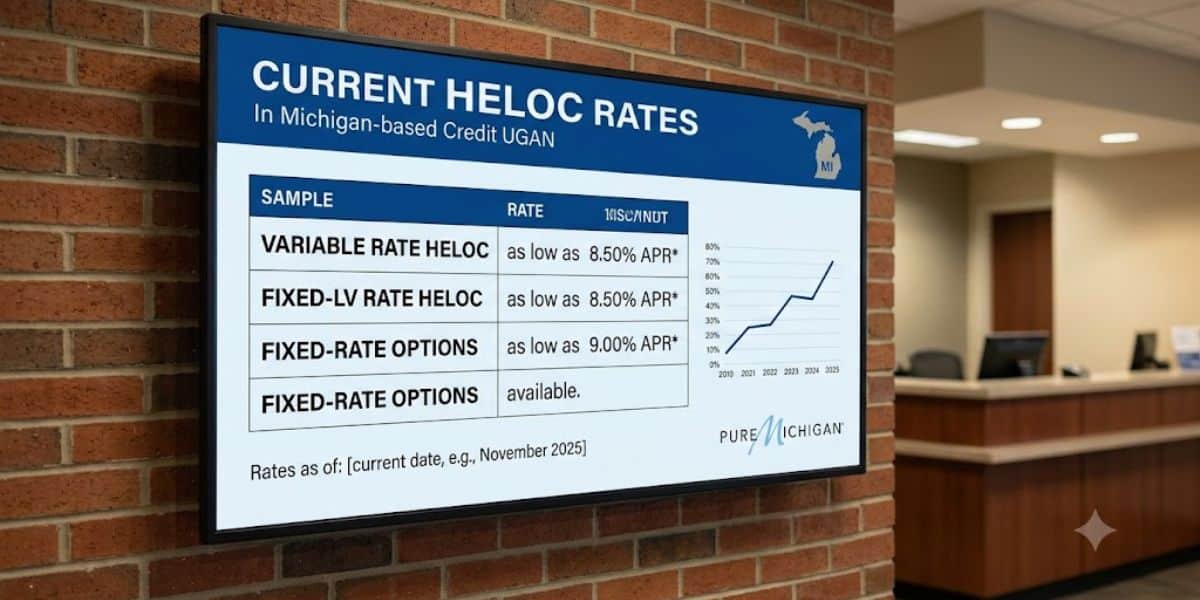
As of September 2026, Michigan HELOC rates generally fall between 6.50% and 10.25% APR, depending on the lender type, your credit profile, and your combined loan-to-value (CLTV) ratio. Most HELOCs carry a variable rate tied to the U.S. Prime Rate, which currently sits at 6.75% following the Federal Reserve’s July 2026 decision to hold its benchmark federal funds rate at 3.50%-3.75%. Lenders typically price HELOCs at Prime plus or minus a margin based on your creditworthiness, so as Prime moves, so does your rate.
| Lender Type | Typical APR Range | Notes |
| Credit unions | 6.50% – 8.75% | Generally the lowest rates; membership required |
| Regional/community banks | 8.25% – 9.25% | Often flexible for existing relationship customers |
| National banks | 8.50% – 10.25% | Convenient but usually priced higher |
| Online lenders | 8.00% – 9.50% | Fast approval, fully digital process |
Many Michigan credit unions are also running limited-time introductory offers. For example, some are advertising promotional rates as low as 2.50%-4.99% APR for the first 6-12 months, after which the rate reverts to a variable rate in the 6.50%-8.50% range. These promotions can meaningfully lower your early borrowing costs, but it’s important to read the fine print on when the introductory period ends and what the fully indexed rate will be afterward.
How Your Credit Score Affects Your Rate?
Lenders use your credit score as one of the biggest factors in setting your HELOC rate. As a general guide for Michigan borrowers:
Excellent credit (720+): Often qualifies for the best available rates, roughly 6.50%-7.25% APR
Good credit (680-719): Typically sees rates in the 7.25%-8.25% range
Fair credit (640-679): Rates often run 8.25%-9.50%, with some lenders applying more restrictive CLTV requirements
Below 640: Approval becomes harder, and if approved, rates are usually at the top of the lender’s range
Improving your credit score even modestly before applying, by paying down revolving balances or correcting errors on your credit report, can meaningfully lower the rate you’re offered.
Loan-to-Value (LTV) and How Much You Can Borrow
Most Michigan lenders allow you to borrow up to 80%-95% of your home’s value, minus your existing mortgage balance. This is expressed as your combined loan-to-value (CLTV) ratio. For example, if your home is worth $400,000 and you owe $250,000 on your mortgage, a lender offering 85% CLTV would let you access up to roughly $90,000 in home equity ($400,000 x 0.85 = $340,000, minus your $250,000 mortgage balance).
A lower CLTV, meaning more equity relative to your home’s value, generally qualifies you for a better rate since it represents less risk to the lender.
Fixed vs. Variable Rate HELOCs
Most HELOCs in Michigan carry a variable rate that adjusts periodically based on the Prime Rate. This means your monthly payment can rise or fall over the life of the loan. Some lenders, however, offer a fixed-rate option, either for the entire line or for a portion you convert to a fixed balance, sometimes called a “rate-lock” feature.
Variable rate: Usually starts lower, but payments can increase if Prime rises
Fixed rate: More predictable, but often starts a bit higher than a variable-rate offer
If you expect to carry a balance for several years, or if rate stability matters to your budget, ask your lender whether a fixed-rate conversion option is available.
Michigan-Specific Costs to Factor In
Beyond the interest rate, Michigan borrowers should budget for a few state-specific costs:
Michigan mortgage recording tax: The state charges approximately $0.75 per $100 of the loan amount recorded (about 0.75%). On a $100,000 HELOC, that’s roughly $750 in state tax.
Property taxes: Michigan property tax rates vary significantly by city; for example, Detroit runs around 2.78%, while Traverse City is closer to 1.08%. Since your home secures the HELOC, lenders will factor your property tax burden into their overall risk assessment.
Closing costs and fees: Many credit unions offer HELOCs with minimal or no closing costs, while some banks charge appraisal, origination, or annual maintenance fees. Always ask for a full fee breakdown before comparing offers.
Top Types of Michigan HELOC Lenders
Credit Unions
Michigan has a particularly strong credit union presence, and these member-owned institutions consistently offer some of the lowest HELOC rates in the state. Many require only that you live, work, worship, or attend school in a certain region to qualify for membership, making them accessible to a wide range of borrowers. Expect the most competitive introductory promotions and lower fees here.
Regional and Community Banks
Regional banks often price HELOCs slightly higher than credit unions but may offer discounts for existing customers with checking accounts or other relationships at the bank.
National Banks
National banks typically have the highest HELOC rates of the three categories, but they offer convenience, established reputations, and often faster funding for borrowers who prioritize a smooth digital experience over the lowest possible rate.
Tips to Get the Best HELOC Rate in Michigan
- Compare at least 3-4 lenders, including credit unions, since rates and promotions vary meaningfully across institutions.
- Check whether a lender offers an introductory rate, and confirm exactly when it expires and what the fully indexed rate will be.
- Improve your credit score before applying; even a modest improvement can shift you into a better pricing tier.
- Keep your CLTV as low as possible by borrowing only what you need.
- Ask about rate caps, since most Michigan HELOCs won’t exceed 18% APR even if Prime rises significantly, but the specific ceiling varies by lender.
- Factor in the full cost, not just the rate, since fees, annual charges, and state mortgage tax all affect your true borrowing cost.
Is Now a Good Time to Get a HELOC in Michigan?
With the Prime Rate holding at 6.75% and the Federal Reserve signaling only a modest chance of a rate cut at its September or October 2026 meeting, HELOC pricing is likely to stay roughly in its current range through the rest of the year. If you’re planning a near-term project or expense, locking in a competitive introductory rate now, particularly through a credit union promotion, can be a reasonable strategy. If your borrowing need is more flexible, keeping an eye on the Fed’s late-2026 meetings may be worthwhile, since even a single 0.25% rate cut would lower variable HELOC pricing accordingly.
Frequently Asked Questions
What is the average HELOC rate in Michigan right now?
As of September 2026, Michigan HELOC rates generally range from about 6.50% to 10.25% APR. Credit unions tend to offer the lowest end of that range, while national banks are typically at the higher end. Many lenders also offer temporary introductory rates as low as 2.50%-4.99% for the first several months.
How much equity do I need to qualify for a HELOC in Michigan?
Most Michigan lenders require you to retain at least 15%-20% equity in your home after the HELOC is factored in, meaning they’ll typically lend up to 80%-85% combined loan-to-value. Some credit unions extend this to 90%-95% CLTV for well-qualified borrowers.
Do credit unions really offer better HELOC rates than banks?
Generally, yes. As member-owned, not-for-profit institutions, Michigan credit unions typically pass savings on to members through lower rates, reduced fees, and more flexible qualification standards compared with traditional banks.
What credit score do I need for the best HELOC rate in Michigan?
Aim for a credit score of 720 or higher to access the most competitive rates. Most lenders require a minimum score of 620-680 to qualify at all, but scores below 720 will typically be priced at a higher tier within the lender’s rate range.
Are HELOC rates in Michigan fixed or variable?
Most HELOCs carry a variable rate tied to the Prime Rate, meaning your rate and payment can change over time. Some lenders offer a fixed-rate lock option on part or all of your balance, which trades a slightly higher starting rate for payment predictability.
How does the Prime Rate affect my Michigan HELOC?
Most HELOCs are priced as Prime plus or minus a margin based on your credit profile. Since the Prime Rate currently sits at 6.75%, it directly sets the baseline for most variable HELOC pricing in the state. If the Federal Reserve cuts rates later in 2026, Prime and your HELOC rate would typically drop by the same amount.
What fees should I expect with a Michigan HELOC?
Common fees include an appraisal fee, origination fee, and sometimes an annual maintenance fee, though many credit unions waive most or all of these. You should also budget for Michigan’s mortgage recording tax, which runs about $0.75 per $100 of the loan amount.
Can I convert my HELOC balance to a fixed rate later?
Many Michigan lenders allow you to lock in a fixed rate on some or all of your outstanding HELOC balance at any point during the draw period, often for a small fee. This can be a useful way to protect against rising rates once you’ve drawn a larger balance.
How long does it take to get approved for a HELOC in Michigan?
Approval timelines vary by lender, but many credit unions and online lenders can approve and fund a HELOC within 2-4 weeks, particularly if an appraisal isn’t required. Traditional banks may take slightly longer due to more extensive underwriting.
Is a HELOC a good option if I own a vacation home in Northern Michigan?
It’s possible, but expect different terms. Non-owner-occupied or seasonal properties in areas like Traverse City, Petoskey, or the Upper Peninsula typically qualify for a lower maximum CLTV (often 75%-80%) and may carry a higher rate than a primary residence HELOC.