


You’ve looked at your credit score and been left a little confused. Why are you seeing two different numbers?
You might check a credit card app and see a score of 720. Then you check your score through another service and see 695.
Don’t worry. This isn’t necessarily a mistake.
There are two widely used credit scoring models in the U.S.: FICO Score and VantageScore. While both are designed to assess credit risk, they calculate scores differently.
Understanding the distinction between these two scoring models is more important than many consumers might realize. If you’re considering a mortgage, auto loan, or new credit card, knowing how each score is calculated and which score your potential lender might use can help you make more informed financial decisions and avoid unwelcome surprises when you apply.
Reliance Financial presents this overview of VantageScore vs. FICO Score to help you better understand your credit standing and prepare for your next financial move.
What Is a FICO Score?
The Fair Isaac Corporation introduced the FICO Score in 1989, and it has long been one of the most widely used credit scoring models in the country. Lenders use FICO Scores for mortgage, auto, credit card, and other lending decisions.
A FICO Score generally ranges from 300 to 850, with a higher score typically indicating lower credit risk.
Although FICO’s exact scoring calculations are proprietary, the company has disclosed the relative importance of five major components used in its widely adopted scoring models:
- Payment History (35%) – If you’ve made timely payments on previous credit accounts
- Debts (30%) – Your total debt and credit utilization ratio
- Length of Credit History (15%) – The age of your oldest account, as well as the average age of all your accounts.
- New Credit (10%)-Recently established accounts and hard inquiries.
- Credit Mix (10%) -The types of credit you manage, such as credit cards, installment loans, and mortgages.
As a shorthand, FICO has had several versions of the scoring model, including FICO 8, FICO 9, and the newer FICO 10 and 10T. However, many lenders (especially mortgage lenders) are still using FICO 2, 4, and 5 because that’s what is incorporated into industry underwriting standards.
What Is a VantageScore?
VantageScore was developed in 2006 by the three major credit bureaus: Equifax, Experian, and TransUnion. It was created as an alternative credit scoring model and can also help score consumers with more limited credit histories.
Like FICO, newer VantageScore models generally use a 300 to 850 scoring range. However, VantageScore evaluates credit information somewhat differently.
VantageScore describes the factors used in its models by their relative level of influence. These include:
- Payment History- Very influential FICO starting point.
- Age and Type of Credit – Highly influential
- Credit Utilization – Highly influential
- Total Balances and Debt – Moderately influential
- Recent Credit Behavior – Less influential
- Available Credit – Less influential
Perhaps the biggest benefit of VantageScore is its capacity to derive scores on consumers with limited credit data. Whereas FICO typically needs at least 6 months of history in order to provide a score, VantageScore can provide a score on a consumer with only one month of history so long as there is a single tradeline. This is particularly helpful for young adults, recent immigrants, or those who are just beginning to establish credit.
How Do the Two Models Score Differently?
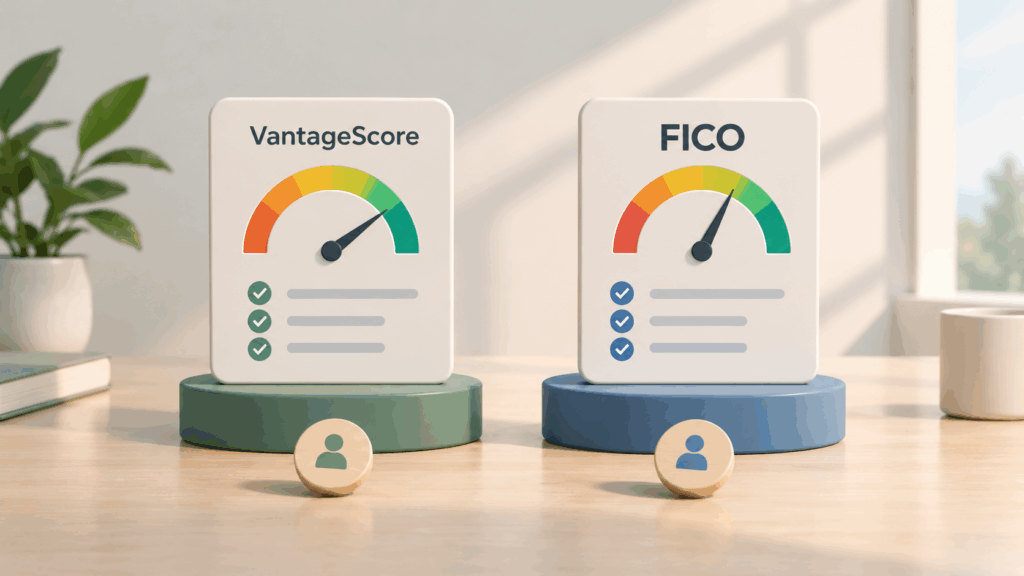
Although both models generally use the same 300-to-850 scoring range, the scores they produce for the same person can differ.
Because each model analyzes and weighs the information in your credit report differently.
Credit Utilization
Both systems consider your credit utilization ratio, which is the percentage of your available revolving credit that you are currently using. However, each scoring model may evaluate your credit information differently, which can cause your scores to vary over time.
Collections and Paid Debts
The previously used FICO models penalize paid collection accounts much more than newer models do. VantageScore 3.0 and 4.0 and FICO 9 and 10 do not even consider paid collection accounts, offering you a significant bump in your score if you ever settle old debts.
Trended Data
VantageScore has included the use of trended data for a long time now to understand changes in your balances or payment behaviors over time, not just a point in time. But FICO added this ability only in its FICO 10T model, which is still not used by many lenders.
Medical Debt
Both scoring models have penalized medical collections less than other types of collections in recent years, as shown by the relative impact of medical collections on scores, in line with industry-wide trends and regulators’ pressures to be more forgiving of medical debt.
Which Score Do Lenders Actually Use?
This is one of the most frequently asked – and most important – questions consumers have. The honest answer is: it depends on the lender and the type of loan.
Most mortgage lenders still use one of the older versions of the FICO score, and many will obtain a score from each of the 3 bureaus and use the middle.
The card issuers may decide to use a FICO score or VantageScore (they will have their own internal underwriting systems).
Auto lenders may also use industry-specific FICO Auto Scores, variations of the basic FICO model, in their lending decisions.
Free credit monitoring applications and services often show VantageScore as it’s easier for bureaus to give out.
As a result, it’s normal for a free app to return a strong VantageScore, while the FICO score your mortgage company pulls may report something just a bit different. If you’re about to buy a house, it’s wise to get your FICO score up front.
Which Score Should You Focus On?
Whether you check your credit daily, weekly, monthly, or simply call up your FICO score once in a while, either score provides a reasonable general indication of your credit standing. The habits that tend to improve your FICO will generally do the same for your VantageScore: making payments on time, maintaining a low credit utilization ratio, avoiding unnecessary inquiries into your credit, and keeping older accounts open.
Even so, if you are actively applying for a specific type of loan – particularly a mortgage – then it may be worth asking what scoring model and version your lender uses. Knowing this means you can accurately know where you are and take specific measures to improve your score prior to applying.
Tips to Improve Both Scores
Make sure to pay every bill on time, every single time. Payment history is the single largest factor in both models.
Keep the ratio of your credit balance to your limit to less than 30%, and preferably under 10%, to achieve the best performance.
Do not close old credit accounts; older account age is advantageous for scoring models.
Keep the number of new credit applications to a minimum and only apply for what you really need, as every hard inquiry affects your credit report;
Examine your credit reports on a frequent basis for inaccuracies and strive to resolve the issues you uncover.
Maintain a healthy mix of revolving and installment accounts to gradually build your credit mix.
The Bottom Line
VantageScore and FICO Score are designed to accomplish a similar goal: help lenders assess the likelihood that a borrower will repay borrowed money. But they use different methodologies, which means the scores they generate won’t always be identical.
Rather than worrying about every small variation between your scores, focus on the financial habits that support a strong credit profile over time. Consistently paying bills on time, managing balances responsibly, limiting unnecessary credit applications, and regularly reviewing your credit reports can benefit your overall credit standing.
For prospective homebuyers, however, there is an additional consideration:
The score that matters most is the one your mortgage lender will actually use. If you’re thinking about buying or refinancing a home and aren’t sure how your credit profile may affect your mortgage options, Reliance Financial can help you understand where you stand before you make your next move.
A conversation before you apply may help you identify potential issues, understand available options, and approach the mortgage process with greater clarity.
Know More. Decide Better.
FAQs
Which score is more accurate?
Both are equally valid – just different scoring models for similar risk. Basing accuracy on the scorecard you use is just as subjective as judging a statistical score by its predictive ability. In the world of credit, that means FICO is dominant on the loan application, but VantageScore can give a better picture with thin credit files.
Can I get my exact FICO Score for free?
Your bank or credit card issuer may provide you with a free FICO score. Alternatively, you can buy your score directly from myFICO.com-however, several free apps tend to show VantageScore instead.
Why did my score change without any new activity?
Scores will change over time as your credit report information is refreshed each month (balance updates, new inquiries made by other people, aging of accounts without activity).
Does closing a credit card affect both scores equally?
Not necessarily. Closing a credit card can reduce your total available revolving credit, which may increase your credit utilization ratio. Different scoring models may evaluate the resulting changes somewhat differently.
Before closing an older credit account, consider how doing so could affect your overall credit profile.
Do employers see my VantageScore or FICO Score?
Neither. Employers who make use of a background check typically obtain a version of a credit report where the credit score has been removed and replaced with information about payment history, debts, and bankruptcies.
Which score matters most for renting an apartment?
It depends on the landlord, property manager, and tenant-screening service. Different companies may use different credit reports, scores, or proprietary screening models. If credit qualification is an important part of your rental application, consider asking the property manager what information will be evaluated.