
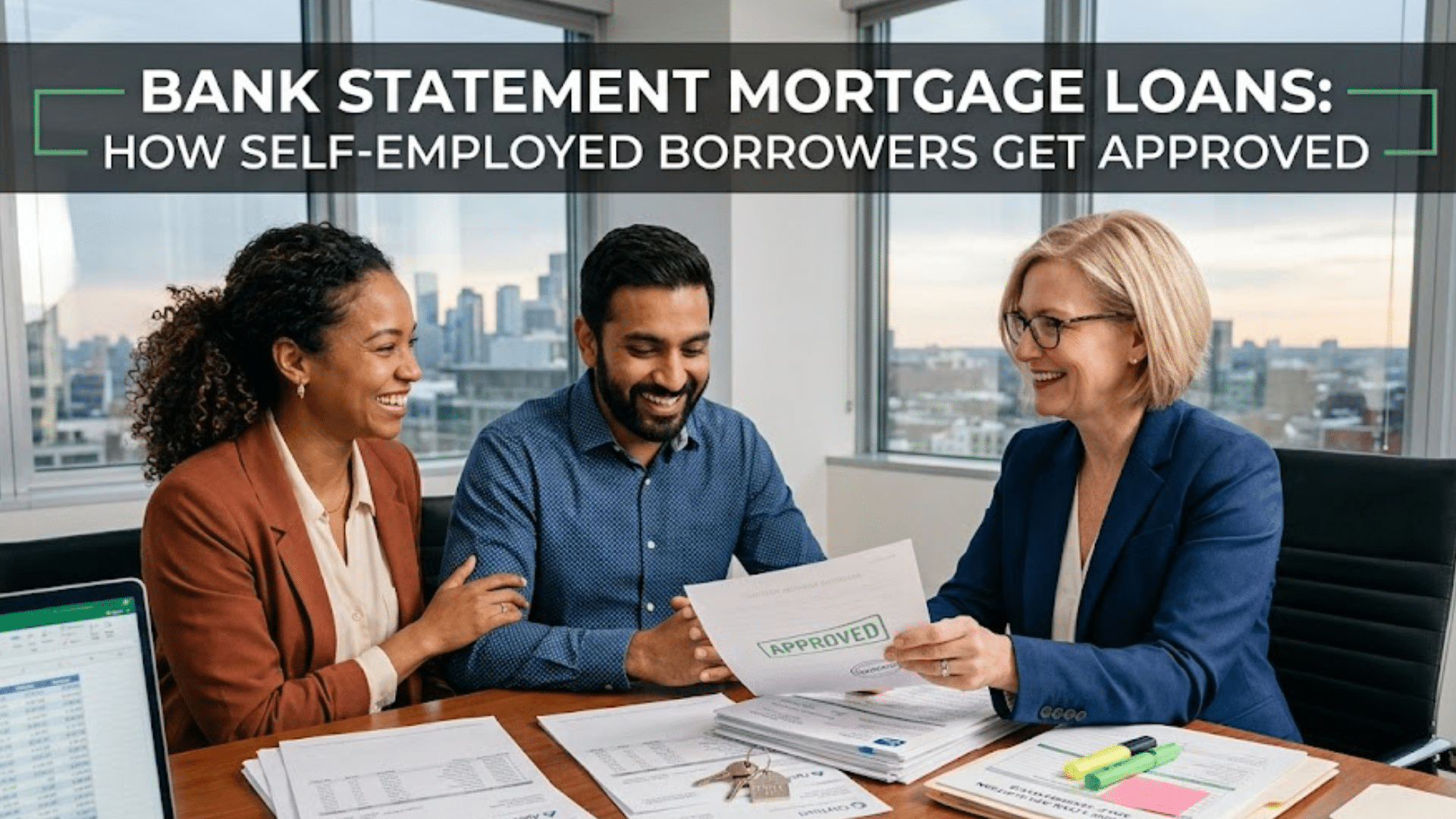
For many self-employed professionals, entrepreneurs, freelancers, and business owners, qualifying for a traditional mortgage can be challenging. Unlike salaried employees who can easily provide W-2 forms and steady pay stubs, self-employed individuals often have fluctuating income, business deductions, and complex tax returns that make it harder to demonstrate consistent earnings. This is where bank statement mortgage loans come in.
Bank statement loans are designed specifically for borrowers who cannot verify income through traditional documentation but still have strong cash flow. In 2026, these loans are becoming increasingly popular as more people move toward self-employment and flexible income structures. Reliance Financial explains how bank statement mortgage loans work, who qualifies, and how self-employed borrowers can improve their chances of approval.
What Is a Bank Statement Mortgage Loan?
A bank statement mortgage loan is a type of Non-QM (Non-Qualified Mortgage) loan that allows borrowers to prove income using bank statements instead of tax returns, W-2s, or pay stubs.
Instead of reviewing declared income on tax returns, lenders evaluate deposits made into personal or business bank accounts over a specific period, usually 12 to 24 months. This gives a clearer picture of actual cash flow, especially for business owners who take advantage of tax deductions that reduce reported income.
These loans are particularly helpful for:
- Self-employed professionals
- Freelancers and consultants
- Small business owners
- Real estate investors
- Gig economy workers
Why Traditional Mortgages Are Hard for Self-Employed Borrowers?
Traditional mortgage lenders rely heavily on tax returns to verify income. However, self-employed individuals often write off business expenses to reduce taxable income. While this is beneficial for taxes, it can make income appear lower than it actually is on paper.
Common challenges include:
- Fluctuating monthly earnings
- High business deductions
- Multiple income streams
- Seasonal revenue variations
- Complex financial documentation
As a result, even financially stable business owners may struggle to qualify for conventional loans.
How Bank Statement Loans Work?
Bank statement mortgage loans evaluate income differently. Instead of focusing on taxable income, lenders analyze cash flow patterns based on deposits.
Step-by-step process:
- Borrower provides 12–24 months of bank statements
- Lender calculates average monthly deposits
- Certain business expenses may be factored in
- A qualifying income figure is determined
- Loan approval is based on this adjusted income
This approach gives lenders a more realistic view of financial stability.
Types of Bank Statements Used
Lenders may accept different types of bank statements depending on your employment setup.
Personal bank statements
Used when business income is deposited directly into a personal account.
Business bank statements
Used when income flows through a company account.
Combined approach
Some lenders analyze both personal and business accounts to determine total income.
Business account statements may require a profit-and-loss (P&L) statement to estimate actual take-home income.
Who Qualifies for Bank Statement Mortgage Loans?
These loans are designed for borrowers with non-traditional income but strong financial discipline.
Typical qualification requirements:
- Self-employed for at least 2 years (sometimes 1 year accepted)
- Consistent bank deposits
- Good credit score (often 620+)
- Down payment of 10%–25%
- Reasonable debt-to-income ratio
Higher credit scores and larger down payments improve approval chances and interest rates.
Benefits of Bank Statement Mortgage Loans
Bank statement loans provide flexibility that traditional loans cannot.
Key advantages:
1) Income flexibilityLenders consider real cash flow instead of tax-reduced income.
2) Ideal for business ownersAllows entrepreneurs to qualify without altering tax strategies.
3) Faster documentation processNo need for complex tax return reviews.
4) Higher loan approval chancesUseful for borrowers who are financially strong but don’t fit standard criteria.
5) Suitable for property investorsHelps investors qualify using rental income and deposits.
Downsides to Consider
While bank statement loans offer flexibility, they also come with trade-offs.
Potential drawbacks:
- Higher interest rates than conventional loans
- Larger down payment requirements
- Fewer lender options
- Additional documentation in some cases
These loans are considered higher risk, so lenders price them accordingly.
How Income Is Calculated?
Income calculation varies by lender, but the general method is consistent.
For personal accounts:
Lenders total monthly deposits and calculate the average income.
For business accounts:
Lenders may apply an expense factor, often assuming 30–50% of deposits go toward business expenses.
For example:
- Monthly deposits: $20,000
- Expense factor: 40%
- Usable income: $12,000 per month
This adjusted figure becomes the qualifying income.
Credit Score Requirements
Credit plays a significant role in approval.
General ranges:
- 720+ : Best rates and terms
- 680–719 : Good approval chances
- 620–679 : May qualify with a higher down payment
- Below 620 : Limited options
Stronger credit helps offset the risk lenders associate with non-traditional income.
Down Payment Expectations
Bank statement loans typically require higher down payments than standard mortgages.
Common ranges:
- Primary residence: 10%–20%
- Second home: 15%–25%
- Investment property: 20%–30%
Larger down payments reduce lender risk and may secure better rates.
Tips to Improve Approval Chances
Self-employed borrowers can take steps to strengthen their mortgage application.
Smart preparation strategies:
- Maintain consistent bank deposits
- Avoid large unexplained transactions
- Improve credit score before applying
- Save for a higher down payment
- Reduce personal debt
- Keep business finances organized
Lenders value financial stability and transparency.
How does Reliance Financial help with Mortgage Loan Approval?
Reliance Financial supports borrowers at every stage of the mortgage loan approval process with personalized guidance, flexible loan options, and expert financial assessment. Their team works closely with applicants to evaluate credit profiles, income sources, and financial goals, helping them choose the most suitable mortgage program.
For self-employed individuals or those with non-traditional income, they assist in preparing bank statements, documentation, and eligibility requirements to strengthen approval chances. Reliance Financial also helps clients improve loan readiness by advising on credit score improvement, debt management, and down payment planning.
With access to a wide range of lending programs, including conventional, FHA, VA, and Non-QM loans, they match borrowers with options that fit their unique situation. From application to closing, their streamlined process, transparent communication, and dedicated support make mortgage approval faster, smoother, and more accessible for first-time buyers and experienced homeowners alike.
Are Bank Statement Loans Safe?
Yes, they are legitimate and widely used by lenders who specialize in Non-QM mortgage programs. However, borrowers should work with reputable lenders and fully understand loan terms, rates, and long-term payment commitments.
These loans are best suited for borrowers with high income but non-traditional documentation.
Future Outlook for Self-Employed Borrowers in 2026
With the rise of entrepreneurship, freelancing, and digital businesses, mortgage lenders are adapting. Bank statement loans are expected to remain an important solution for self-employed individuals who need alternative income verification methods.
As the workforce evolves, lending models are becoming more flexible, giving business owners better access to home financing.
Frequently Asked Questions
1) What is a bank statement mortgage loan?
It’s a home loan that allows borrowers to qualify using bank statements instead of tax returns or pay stubs.
2) Who should consider bank statement loans?
Self-employed professionals, freelancers, business owners, and gig workers with strong cash flow.
3) How many bank statements are required?
Most lenders require 12 to 24 months of statements to evaluate income consistency.
4) Are bank statement loans more expensive?
Yes, interest rates are usually higher than traditional loans because they carry more lender risk.
5) What credit score is needed?
Many lenders prefer a score of 620 or higher, though better scores improve loan terms.
6) Can I use business bank statements only?
Yes, some lenders accept business statements, often with a profit-and-loss summary.
7) How is income calculated from deposits?
Lenders average monthly deposits and subtract estimated business expenses to determine usable income.